
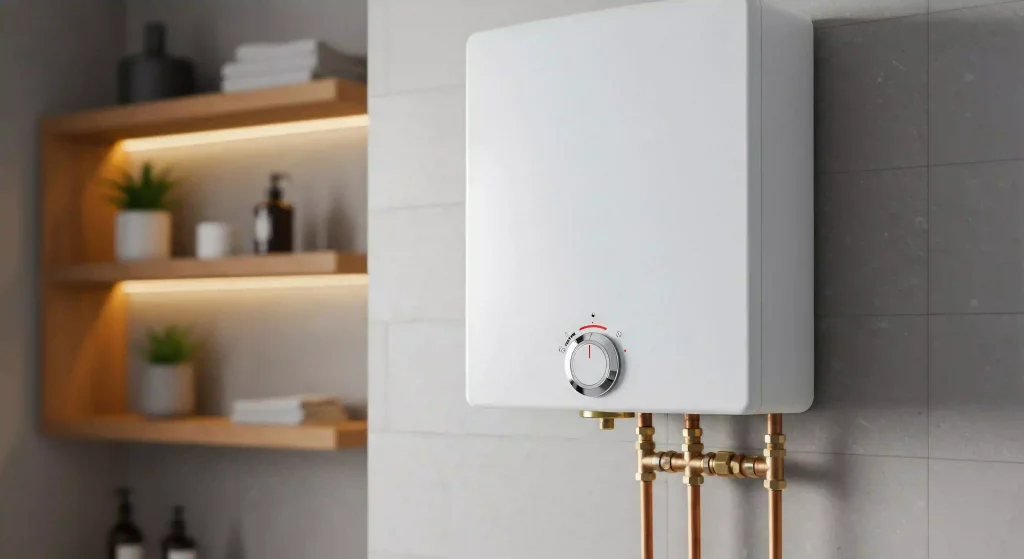
Understanding the Two Systems and What Sets Them Apart
When homeowners in San Diego consider replacing their water heating system, the choice between tankless and traditional tank models represents one of the most significant decisions they will make for their home’s utility infrastructure. Traditional tank water heaters store and continuously heat 30 to 80 gallons of water, maintaining a ready supply at all times. Tankless systems, by contrast, heat water instantaneously as it flows through the unit, delivering hot water on demand without storage.
The fundamental difference lies in how each system operates. Tank heaters cycle on and off throughout the day to maintain water temperature, consuming energy even when no hot water is being used. Tankless units remain dormant until a hot water tap opens, then activate immediately to heat water as it passes through a heat exchanger. This operational distinction affects everything from utility bills to installation requirements to household water delivery patterns.
San Diego’s relatively mild climate and hard water conditions influence both systems differently. Hard water containing elevated mineral content accelerates sediment buildup in traditional tanks, requiring more frequent flushing and potentially shortening lifespan. Tankless systems, while also affected by mineral deposits, can be descaled more effectively during routine maintenance. Homeowners who understand these foundational differences can make informed decisions aligned with their household size, budget constraints, and long-term ownership plans.
What Does It Actually Cost to Install Each System?
Initial installation costs represent the most significant financial barrier for homeowners considering an upgrade. In the San Diego area, a standard 40 to 50 gallon traditional tank water heater typically costs between $1,200 and $2,500 installed, including the unit, labor, permits, and basic connection work. Gas models generally cost slightly more than electric versions due to venting requirements and gas line connections.
Tankless water heater installation presents a substantially higher upfront investment, typically ranging from $3,000 to $5,500 for a whole-house gas unit installed. This premium reflects several factors: the units themselves cost more to manufacture, installation often requires upgrading gas lines to accommodate higher BTU demands, electrical systems may need enhancement to power the unit’s electronics, and venting requirements differ from traditional systems. Electric tankless units cost less to install but may require significant electrical panel upgrades in older homes.
San Diego building codes and permit requirements add to the total investment, particularly for tankless installations that modify existing utility infrastructure. Homes built before 1990 often require additional work to meet current code standards when upgrading to tankless systems. Many homeowners hesitate at this initial cost difference, yet focusing solely on installation price overlooks the total cost of ownership calculation. The higher upfront expense of tankless systems must be weighed against operational savings, longevity, and the value of unlimited hot water delivery. For households planning to remain in their home for a decade or more, the initial premium often yields positive returns through reduced energy consumption and extended equipment life.
How Much Will Each System Cost to Operate Over Time?
Operating costs over the system’s lifespan often determine which option delivers better financial value. Traditional tank water heaters consume energy constantly to maintain water temperature, a phenomenon known as standby heat loss. A typical tank system in San Diego costs approximately $400 to $600 annually to operate, depending on household size, fuel type, and usage patterns. This continuous energy consumption occurs regardless of actual hot water demand, meaning you pay to heat water even while sleeping or away from home.
Tankless systems eliminate standby heat loss entirely by heating water only when needed. The U.S. Department of Energy estimates that tankless water heaters can be 24% to 34% more efficient for households using 41 gallons or less of hot water daily, and 8% to 14% more efficient for households using around 86 gallons daily. Translated to actual dollars in San Diego, where natural gas prices average $1.50 per therm, a tankless system typically costs $250 to $400 annually to operate for an average household.
Over a 15-year period, this efficiency advantage compounds significantly. A household spending $500 annually on tank water heating will invest $7,500 in energy costs. The same household using a tankless system at $325 annually spends $4,875, a savings of $2,625 over the comparison period. These figures assume stable energy prices, though historically utility costs trend upward, potentially increasing the long-term advantage of more efficient systems. When combined with the extended lifespan of tankless units, the operational savings help offset the higher initial installation investment, particularly for households with moderate to high hot water usage.
Which Water Heater System Makes the Most Sense for Your Home?
Equipment lifespan dramatically affects true ownership costs when factoring in replacement cycles. Traditional tank water heaters typically last 10 to 13 years with proper maintenance. San Diego’s hard water accelerates internal corrosion and sediment accumulation, sometimes reducing this lifespan to 8 to 10 years for units that do not receive annual flushing and anode rod replacement. Once the tank begins leaking, immediate replacement becomes necessary, often at an inconvenient time.
Tankless water heaters generally last 20 to 25 years, nearly double the lifespan of tank systems. This extended durability stems from their design: without a storage tank to corrode, the primary wear occurs in the heat exchanger and electronic components, both of which prove more durable than tank structures. Regular descaling to remove mineral buildup extends tankless system life, particularly important in areas with hard water. While tankless units require periodic maintenance, including annual flushing and occasional replacement of filters or sensors, these routine services cost less than premature system replacement.
The replacement cycle difference substantially impacts long-term costs. Over a 25-year period, a homeowner will purchase and install two to three traditional tank systems at a combined cost of $3,600 to $7,500. The same homeowner installing a single tankless system pays $3,000 to $5,500 once, with only maintenance expenses thereafter. This longevity advantage, combined with operational savings, positions tankless systems as financially advantageous for long-term homeowners. Water quality, usage patterns, and consistent maintenance significantly influence actual lifespan for both systems. Homes in San Diego neighborhoods with particularly hard water benefit from water softeners or conditioners that protect both system types from accelerated mineral damage.
How to Decide What’s Right for Your Household and Budget
Choosing between tankless and traditional tank systems requires careful consideration of your household’s specific needs, financial situation, and long-term plans. Neither option is universally superior, each delivers distinct advantages depending on your priorities and circumstances.
Households with high simultaneous hot water demand, such as families that run multiple showers, dishwashers, and washing machines concurrently, may find traditional tank systems more forgiving. A 50-gallon tank can supply several fixtures at once without the flow rate limitations that affect tankless units. For San Diego families with four or more occupants and overlapping morning routines, this capacity buffer often justifies the higher operating costs.
Conversely, households with space constraints, longer ownership timelines, or lower peak demand benefit significantly from tankless systems. Homeowners planning to stay in their residence for 15 years or more will typically recover the higher installation cost through energy savings and extended equipment lifespan. Properties with limited utility closet space or those undergoing bathroom additions gain valuable square footage when switching from bulky tank systems to wall-mounted tankless units.
Budget considerations also shape the decision. If upfront capital is limited and the existing gas line and electrical infrastructure support a direct tank replacement, a traditional system offers an economical solution that restores hot water service quickly. However, homeowners with available capital who prioritize long-term savings and efficiency should seriously evaluate tankless options, particularly when installing new systems during remodels or new construction.
For guidance on which system best matches your household’s water usage patterns, existing infrastructure, and financial goals, contact a qualified local service provider. Professional assessment of your home’s gas line capacity, electrical service, venting requirements, and daily hot water consumption provides the foundation for a decision that serves your family well for years to come. Whether you need water heater installation, system evaluation, or maintenance planning, getting the right system installed correctly ensures maximum performance and value from your investment.